Hard Water vs. Soft Water: Should You Install a Water Softener in 2026?
About 85% of U.S. homes have hard water, according to the U.S. Geological Survey — meaning more than 7 grains per gallon of dissolved calcium and magnesium. Hard water won't hurt your health, but it will cost you thousands over a decade in shortened appliance life, extra detergent, and replaced fixtures. The real question isn't whether your water is hard. It's whether the math of a softener works for your house.
How Hard Is Your Water?
Hardness is measured in grains per gallon (gpg) or parts per million (ppm). 1 gpg ≈ 17 ppm.
- 0–1 gpg — Soft
- 1–3.5 gpg — Slightly hard
- 3.5–7 gpg — Moderately hard
- 7–10.5 gpg — Hard
- 10.5+ gpg — Very hard
Get a free test kit from your municipal water provider, buy a $10 strip test at a hardware store, or order a lab kit ($25–$60) for an accurate breakdown. Your annual Consumer Confidence Report (covered in our PFAS in tap water guide) usually lists hardness too.
The Real Costs of Hard Water
Hardness above 7 gpg costs the average household roughly $200–$400/year in measurable wear-and-tear:
- Water heater life cut by 30–50%. Scale insulates the heating element from the water it's heating, forcing longer run cycles and cracking the dip tube faster. A $1,400 unit replaced 5 years early = $280 a year.
- Faucet and shower head replacement. Aerators clog within 12–18 months. Cartridges seize.
- 30–50% more detergent. Hardness binds soap, so dishwashers, washing machines, and showers all need more product.
- Dishwasher repairs. Scale ruins spray arms and heating elements.
- Cosmetic damage. Permanent scale rings on toilets, sinks, and glass shower doors.
Symptoms you'd recognize: white scale on faucets, soap that won't lather, "spotty" glassware, stiff laundry, dry skin and hair after showering, and rumbling water heaters (a sign covered in our water heater noise guide).
How a Water Softener Actually Works
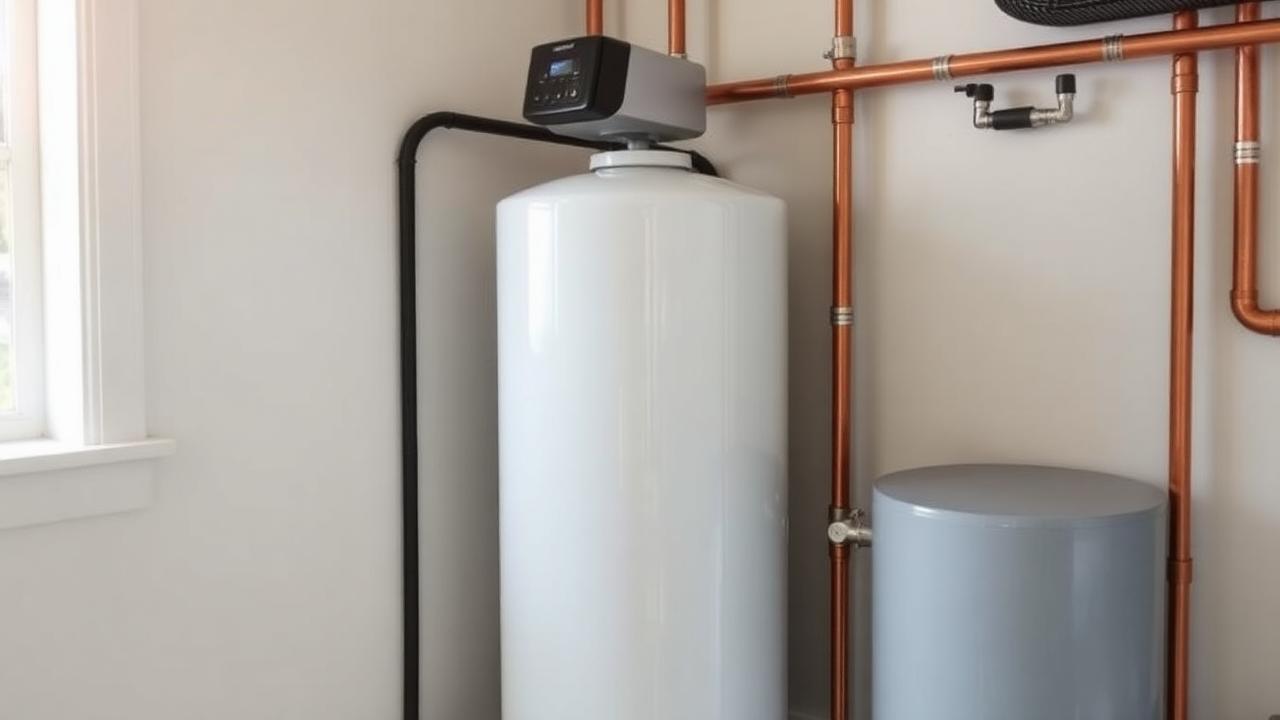
A traditional softener uses ion exchange: hard water flows through a tank of resin beads that swap out calcium and magnesium ions for sodium ions. Every few days, the system "regenerates" by flushing the resin with concentrated salt water (brine) from a second tank, washing the captured minerals down the drain.
Modern softeners are demand-initiated — they only regenerate based on actual water use, not a fixed schedule. This cuts salt and water usage 30–50% versus older timer-based units.
What a Softener Costs (Installed, 2026 U.S. Pricing)
- Entry-level (32,000-grain) — $700–$1,200 unit + $400–$800 install = $1,100–$2,000
- Mid-range (48,000-grain, smart Wi-Fi) — $1,200–$1,800 unit + $500–$900 install = $1,700–$2,700
- Premium (high-capacity, twin-tank) — $2,000–$3,500 + install = $2,500–$4,500
Annual operating cost: $120–$250 for salt (8–12 bags/year at ~$8 each) plus a few dollars of extra water for regeneration.
Salt-Free "Softeners" — Honest Take
Devices marketed as "salt-free water softeners" don't actually soften water — they don't remove calcium or magnesium. They use template-assisted crystallization (TAC) to convert dissolved hardness into microscopic crystals that don't stick to pipes. The result:
- Less scale buildup ✓
- Soap still doesn't lather well ✗
- Glassware still spots ✗
- No salt, no waste water, no electricity ✓
TAC systems work best as scale prevention — protecting your water heater and plumbing — without the "slippery" feel real softening gives. They cost $800–$1,800 installed, and they're a good fit for homes on septic systems or in areas with sodium-restricted discharge rules.
Is a Softener Worth It for You?
Install one if:
- Hardness is above 7 gpg
- You're replacing your water heater (great time to add it)
- You're staying in the house 5+ years
- You have a tankless water heater (scale is its #1 killer)
Skip it if:
- Hardness is below 5 gpg — not enough payoff
- You're on a strict sodium-restricted diet (use potassium chloride instead, or pick a TAC system)
- You discharge to a septic system in a sodium-sensitive area
- You're moving in <3 years (you won't recoup install cost)
If You're Already Choosing a New Water Heater
Pair the softener decision with your tankless vs. tank water heater choice. Tankless heaters in hard water without softening lose 40–60% of expected lifespan and need annual descaling. A softener pays for itself faster when paired with tankless.
Eco Considerations
Ion-exchange softeners use 25–50 gallons per regeneration. Modern demand-initiated units regenerate 2–3 times a week — about 4,000–8,000 gallons a year of wastewater plus the brine discharge. Some California water districts have outlawed traditional softeners due to chloride loading on local sewage plants. Always check your district's rules before installing. For other green plumbing upgrades, see our eco-friendly upgrades guide.
Internal Links
- Picking a new water heater? Read Tankless vs. Tank: Which Heater Is Right for You.
- Hearing scale-related noises? See Water Heater Making Noise: Causes and Fixes.
- Browse more in Pipes & Drains and Eco-Friendly Plumbing.
Key Takeaways
- 85% of U.S. homes have hard water; test first, decide second.
- Hardness above 7 gpg costs $200–$400/year in measurable wear.
- Full installation: $1,100–$2,700 for most homes.
- Salt-free TAC systems prevent scale but don't truly soften.
- Pair softener install with water heater replacement for best ROI.
Test your water before you shop. Then explore more system upgrades in our Eco-Friendly Plumbing category.
Frequently Asked Questions
- How do I know if I have hard water?
- Look for white scale on faucets and shower heads, soap that won't lather, spots on glassware, stiff laundry, and dry skin after showers. A $10 strip test from any hardware store will confirm in 30 seconds. Anything above 7 grains per gallon is considered hard.
- Is softened water safe to drink?
- Yes, for almost everyone. Ion-exchange adds a small amount of sodium — about 12.5 mg per glass for 10 gpg water. That's less than a slice of bread. People on strict low-sodium diets can use potassium chloride instead of salt, or install a reverse osmosis unit at the kitchen sink for drinking water.
- How long do water softeners last?
- Resin tanks last 10–15 years; control valves often 12–20 years. Brine tanks last 20+ years. Annual cleaning of the brine tank and the right salt type (pellet, not rock) extends life significantly.
- Are salt-free water softeners as good as salt-based?
- For scale prevention, yes — TAC systems do reduce scale buildup on pipes and water heaters. For the 'soft water feel,' lathery soap, and spot-free dishes, no — only ion-exchange softeners actually remove the minerals.
Found this helpful?
Share it with a homeowner who needs it, or explore more guides in Pipes & Drains.
Related reading
Slab Leak Warning Signs (And What to Do Before It Gets Expensive)
Slab leaks are sneaky and expensive — here's how to catch one early.
Low Water Pressure in the Whole House: 8 Causes and How to Fix Each
If every fixture in the house dribbles, the problem isn't your showerhead — it's somewhere upstream. Here's how to find it.